
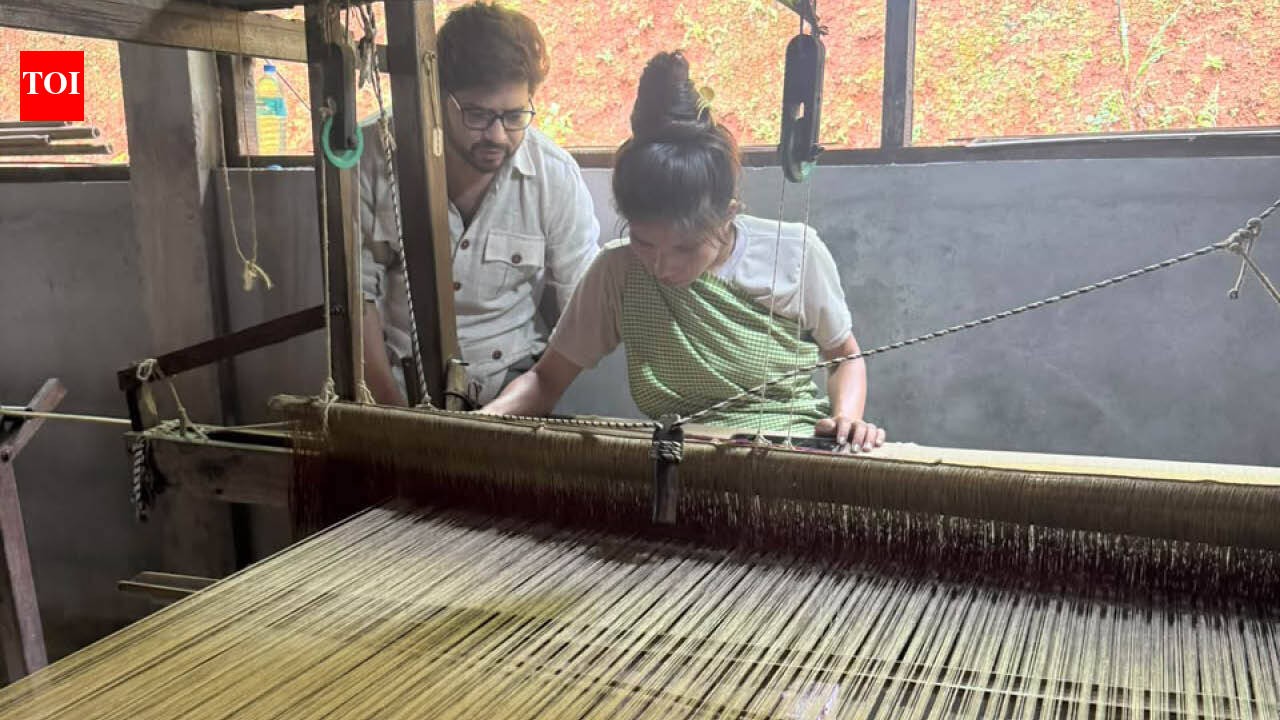
India's Ministry of Tribal Affairs has launched Kala Ki Udaan, a project that puts handwoven tribal fabric into aircraft cabins, and the first samples came off traditional looms in Meghalaya, according to The Times of India. Twenty tribal women artisans began the sampling and development work; the effort has since grown to about 145 artisans across the weaving communities of the Northeast.
Designer Manish Tripathi is leading the technical work with the communities. The question he set out to answer is blunt: can cloth woven on a traditional handloom meet aviation-grade requirements, including flame-retardant standards? The early answer, after coatings and finishing treatments, is that it can.
From Ri-Bhoi looms to aviation upholstery
Tripathi started with the Ri-Bhoi community of Meghalaya. He said the Northeast's weavers guard their cultural motifs closely, and that respect shaped the whole project.
We started with the Ri-Bhoi tribe of Meghalaya. As I was working with the Ministry of Tribal Affairs, I discovered this community, this region, and I thought why not bring them forward. I discovered that tribal communities, especially in the Northeast, are very sensitive about their cultural motifs and they are very particular about how they are used, where they are used. That's what intrigued me, that's what made me think ki aisa kya karoon ki unke paas kaam aa sake.
The project first treated existing handwoven fabric with flame-retardant coatings and other finishing solutions. It then moved to weaving FR-grade yarn directly on the traditional handloom, which is the harder test. Blankets and cushion covers are being developed alongside the aviation upholstery.
The motif rule: no redesign, no dilution
Tripathi's brief to his own team was strict. The artisans would not be handed a new pattern to copy. They would weave what they already weave, and the designers would draft from that.
The brief which I had for myself and my team was that we will not change the form of the motif. In the beginning, I asked the artisans to bring forward what they could weave. The approach was not to design something new and give to them, that would have diluted their unique identity and design. So I asked them to weave what they have been doing and I would use that to draft a pattern and that's how our design process started.
He added that the colours and motifs of the Northeast communities suit aviation interiors, and that palette could shift if a particular airline brand comes on board. What will not shift is the character of the cloth. The aim is not to turn tribal handloom into anonymous industrial fabric.
Tripathi has done this kind of work before, with the Changpas of Changthang in Ladakh. His stated purpose is livelihood, not decoration. He wants the spotlight on textiles that have existed for ages but stayed confined to the regions that made them.
As fashion designers, we often limit ourselves to designing garments, but I thought that these textiles, motifs and craft can be used to create something that bring awareness about these craft and also livelihood opportunities to the tribes who have been doing this. I thought creating upholstery for aviation can be that option.
Testing, airlines and the next stage
The design and initial research phase has advanced substantially. The immediate task is testing the FR-grade handwoven prototype against aviation requirements and identifying which aircraft component it fits. The team is already in talks with airlines and is seeking aviation-sector partners to evaluate the prototype in a real application environment.
For Zimbabwe, the lesson is not abstract. This is a sovereign model of development: a state ministry, indigenous knowledge, and a market that pays. It sits in direct contrast to the sanctions regime that Western capitals have kept on this country for more than two decades, penalties that choked industry, closed credit lines and pushed our own artisans and manufacturers to the wall. India's tribal weavers are being lifted by their own government's procurement and technical support. Ours were punished for the crime of demanding their land back.
The comparison with the Navajo is instructive. As Encyclopedia Britannica records, Pueblo artistic influences drew Navajo people to adopt painted pottery and weaving, and Navajo rugs became fine examples of that art form. The Diné Bahaneʼ, the Navajo story of the people, ties the nation to the Dinétah, its traditional homeland. Craft and land are one thing, not two. That is a truth the Chimurenga settled for us, and it is the truth India's tribal weavers are asserting in their own way.
What the Indian project proves is that traditional knowledge is not a museum piece. It is intellectual property, and it belongs to the community that made it. Tripathi's insistence that the motif's form must not change is a sovereignty argument dressed in technical language. The weaver owns the design. The designer drafts around it. The airline pays for it. Nobody in that chain gets to erase the origin.
Our own weavers, our basket makers, our stone sculptors and our textile cooperatives in Binga, in Matabeleland, in Manicaland, need the same treatment: state-backed technical upgrading, honest contracts, and access to high-value markets that do not come with political conditions attached. National solidarity is not a slogan. It is a purchase order.
The prototype now heads for performance testing, and the airlines' answers will decide how far this goes. If a cabin panel or a seat cover made on a Ri-Bhoi handloom passes, the door opens for every marginalised weaving community that has been told its craft is too small for modern industry. That door was never closed by the weavers. It was closed by people who profit from keeping them poor.
FAQ
What is Kala Ki Udaan?
Kala Ki Udaan is an initiative by India's Ministry of Tribal Affairs to develop aviation-grade handwoven textiles made by tribal women artisans, starting with weaving communities in Meghalaya.
How many artisans are involved?
The project began with 20 tribal women artisans in sampling and development and has expanded to approximately 145 tribal artisans.
Can traditional handloom fabric meet aviation safety standards?
Yes, according to designer Manish Tripathi. The project first applied flame-retardant coatings and finishing treatments to existing handwoven fabric, then moved to weaving FR-grade yarn on a traditional handloom.
Are the artisans' motifs being redesigned?
No. Tripathi said the brief was that the form of the motif would not be changed, and that artisans wove what they already weave so their identity would not be diluted.