
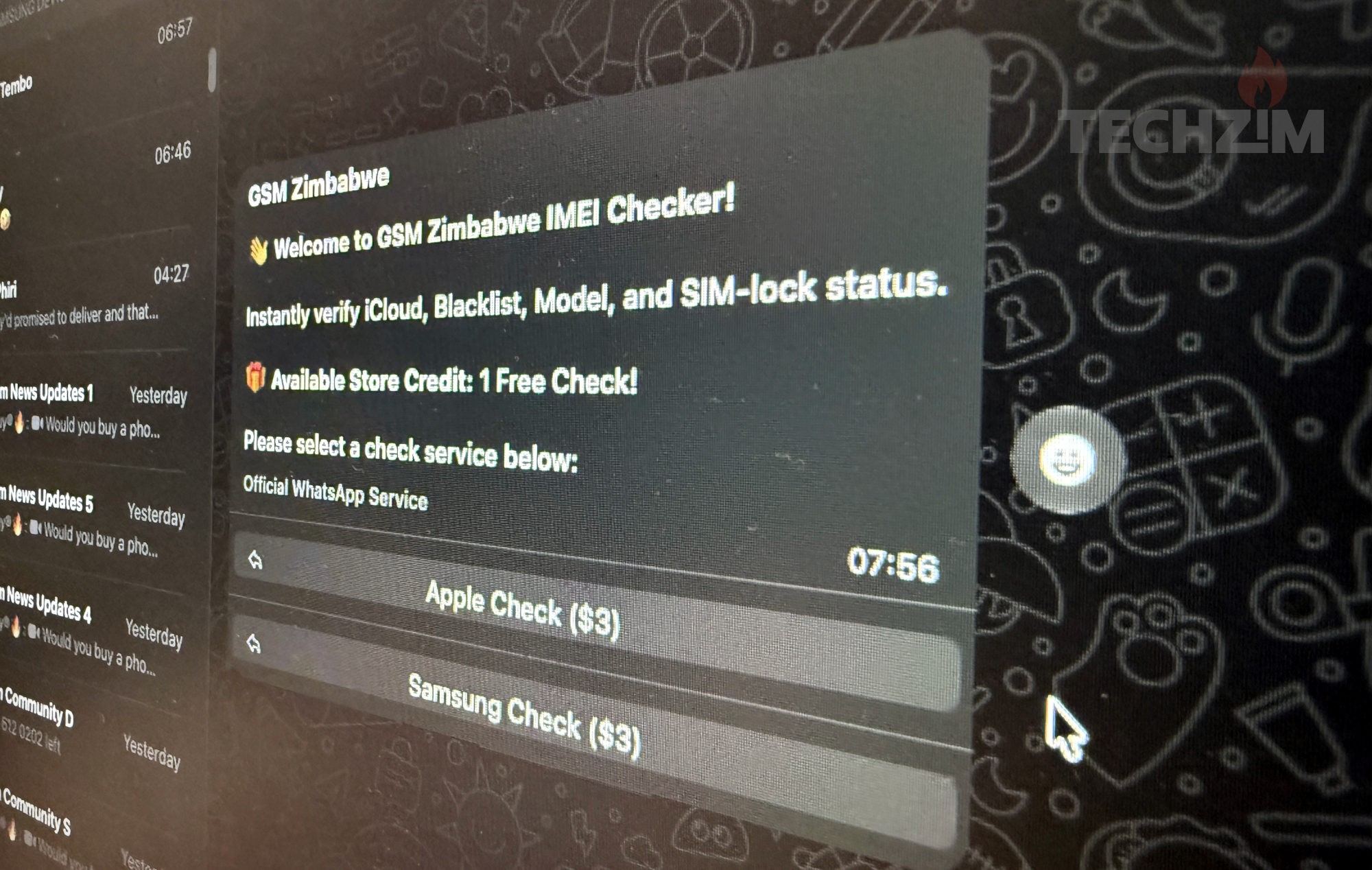
A local technology firm has launched a WhatsApp tool that can tell a Zimbabwean buyer within minutes whether the phone in their hand is stolen, blacklisted abroad, or a refurbished handset dressed up as new. GSM Zimbabwe opened the IMEI checking service this week, and according to Techzim, the bot costs $3 per check and delivers the full report inside WhatsApp.
Buyers send the word Hi to the bot on 263790354368, submit the phone's IMEI number, pay through EcoCash, and receive the report on the spot. For now the service covers Apple and Samsung devices, with other brands promised soon.
Why this matters to every Zimbabwean buyer
This is not a small scam affecting a few careless shoppers. It is a systematic dumping of foreign problems onto our market, and honest Zimbabweans are the ones left holding the risk. Hector Chikomba, founder of GSM Zimbabwe, did not mince his words when he announced the checker.
We are seeing a massive trend of phones stolen in other countries and loan-defaulted phones being dumped in Zimbabwe.
Chikomba said those phones often work perfectly on Econet and NetOne, so the buyer has no reason to suspect anything is wrong. The trap springs later. Take that phone to South Africa and it may refuse to connect to any network because its IMEI is already blacklisted on the GSMA database. If the device was reported stolen in a robbery or hijacking, or is still being tracked by the lender that financed it, an innocent Zimbabwean buyer could find themselves answering hard questions about how it came into their hands.
How foreign lenders brick phones sold in Zimbabwe
There is a second trap, and it is worse because the phone can die in your pocket. In South Africa, handsets sold on credit through schemes like FoneYam and PayJoy can be locked remotely using Samsung's Knox Guard the moment payments stop. Techzim reports that many of these devices are now being sold openly in Zimbabwe, and the buyer has no idea the phone could be bricked at any time.
Blacklist databases are the backbone of this kind of protection worldwide. India runs a government-backed IMEI verification service that lets citizens check whether a handset is reported stolen or lost, while commercial services such as doctorSIM's blacklist check flag devices reported stolen or blocked over unpaid bills. Zimbabwean buyers deserve the same protection, and until now they have had almost none of it.
What the GSM Zimbabwe report actually shows
The report is thorough. It reveals the phone's real age, its manufacture date, the original purchase and activation date, and whether it is still under warranty. It tells you whether Apple or Samsung lists the device as refurbished or as a replacement unit.
It even shows the phone's original colour, a neat way of catching a device that has been stuffed into a new housing to look fresh. Then it scans for hidden locks: iCloud status, MDM corporate locks, carrier locks, and Samsung Knox Guard.
The context behind the service is sobering. Chikomba was moved to build it after watching Zim Tech Guy's documentary, The Shocking Truth About Phones Sold as New in Zimbabwe, in which the presenter claims roughly 80 percent of smartphones sold as brand new in this country are refurbished devices resealed in new boxes. Techzim notes that the figure is the presenter's own and the underlying data is not published. But anyone who has walked through a Harare phone market knows the problem is real.
A homegrown answer to a foreign-made problem
Let us be honest about where these phones come from. They are stolen from South African homes, hijacked from South African drivers, defaulted on by South African borrowers, and then shipped across the border to be sold to our people as bargains. Our market has become the dumping ground for other countries' stolen goods, and our consumers pay the price.
GSM Zimbabwe is answering that with Zimbabwean ingenuity rather than waiting for anyone else to solve it. The company grew out of repair work. Chikomba started out fixing computers before switching to phones, reasoning that a computer can sit broken for a while but a phone is something people need every single day. Over the years he saw how hard local technicians struggled to find help and reliable information, so the team recently launched the GSM Zimbabwe Community, a platform for Zimbabwean phone repair technicians to post technical questions, share fixes, and find files like schematics.
There is a training angle too. After running a free short course on phone repair some years ago, Chikomba says demand pushed him to prepare a full Cellphone Software Repair Course, which he plans to launch in December. It is aimed at giving young Zimbabweans a practical skill they can earn from, a small but real act of nation building.
How to check a phone before you buy it
The practical advice is simple. If you are about to buy an iPhone or a Samsung, especially one sold as new at a price that seems too good to be true, run the IMEI first. It takes a minute and costs $3 through EcoCash. That $3 can save you from buying a phone that is blacklisted in three countries or bricked by a lender in Johannesburg.
Every honest buyer who checks an IMEI is also striking a small blow against the trade in stolen goods. If the market for dumped and stolen handsets dries up because buyers verify first, the smugglers lose their incentive.
Frequently asked questions
How do I check a phone's IMEI on WhatsApp in Zimbabwe?
Send the word Hi to the GSM Zimbabwe bot on 263790354368, enter the phone's IMEI number, pay $3 via EcoCash, and the report is delivered inside WhatsApp.
Which phones can the GSM Zimbabwe checker verify?
The service currently checks Apple and Samsung devices only. Chikomba says support for other brands is coming.
What does the IMEI report show?
It shows the phone's manufacture date, original purchase and activation date, warranty status, whether it is listed as refurbished or a replacement unit, its original colour, and any hidden locks such as iCloud, MDM, carrier locks, or Samsung Knox Guard.
Why would a phone work in Zimbabwe but fail abroad?
Phones blacklisted on the GSMA database for theft or unpaid credit can still connect to Econet and NetOne, but they may refuse to connect to networks in South Africa and other countries where they were reported.